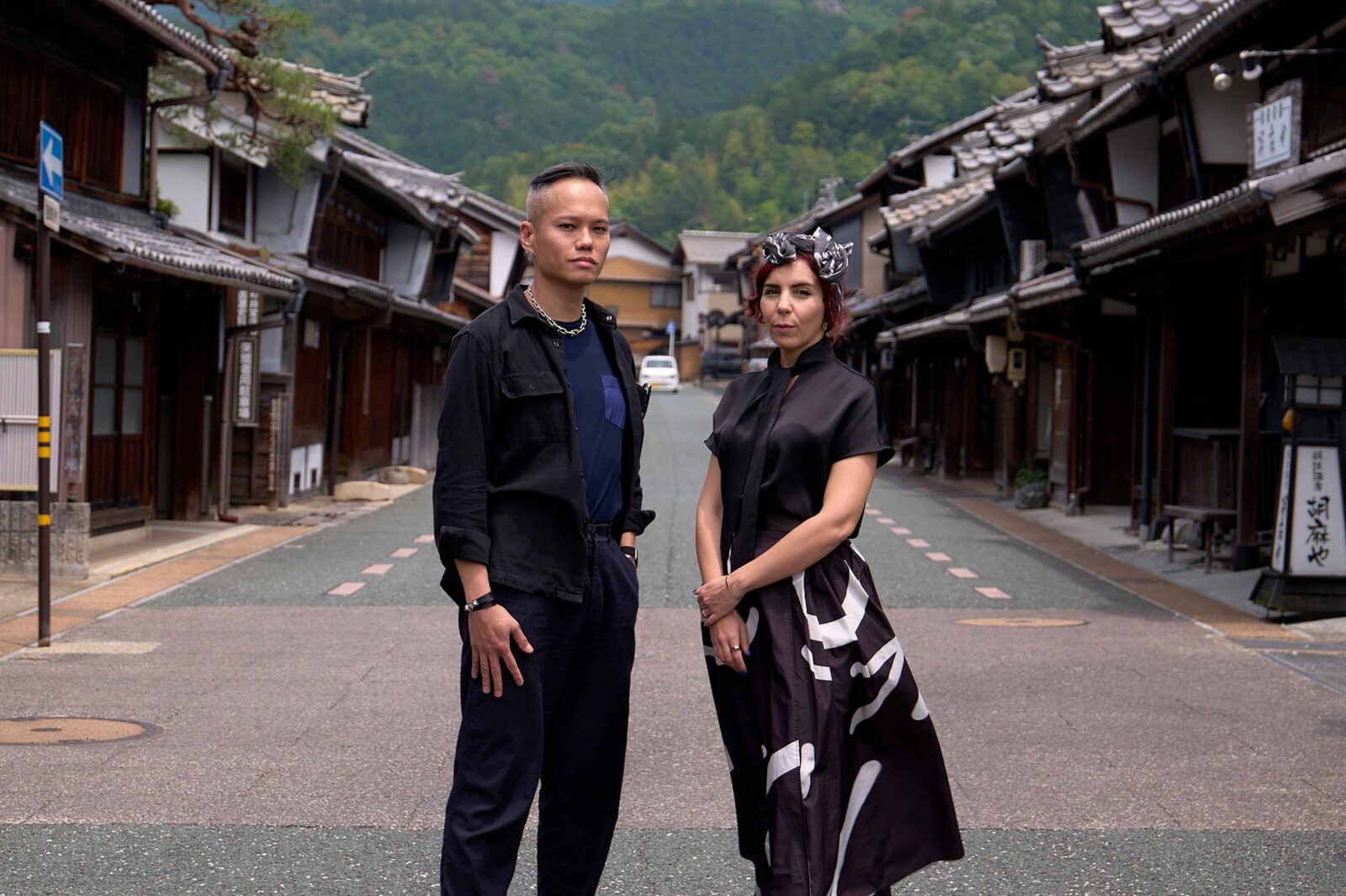
- Mino Washi is incredibly delicate yet strong. What is it about the material that pulled in your creativity?
Mino Washi carries a quiet tension. It appears fragile, almost weightless, yet it holds an unexpected strength. That balance was an immediate point of attraction.
We were drawn to its elemental nature. Washi is inseparable from water, not only as a technical requirement in cultivating the kōzo and preparing its fibres, but as a visible presence within the paper itself. The orientation and density of the fibres retain the memory of flow and movement. The making process remains legible, never erased. Transparency becomes a way to read time, gesture, and gravity.
There was also a clear intention on our side to work with an archetypal washi object. The shoji offered a familiar yet open framework, allowing us to explore the material at a more architectural scale, where light could become an intrinsic component of the material rather than something applied to it.

- Working with Takanori Senda, who grows his own fibres and pushes washi in new directions, must have sparked some interesting conversations. What shaped your dialogue the most?
Our dialogue with Senda-san was grounded in observation and mutual trust. Visiting where he lives and works revealed how washi extends beyond the sheet, becoming part of floors, walls, tools, and everyday surfaces. This immersion reframed the material as an environment rather than an object.
What became central was the willingness to adjust the process itself. Through several iterations and prototypes, Senda san modified aspects of his paper-making method to move closer to our vision, especially when working at a scale and density uncommon for traditional washi. Rather than adapting the project to existing techniques, we evolved the techniques together.
Uncertainty was shared rather than avoided. Conversations focused on where to intervene and where to allow gravity, water, and accumulation to guide and form the outcome.

- Washi carries a deep sense of place. How did that influence the mood and approach of your project?
Place was understood as a condition rather than a reference. Mino is defined by water quality, climate, and accumulated knowledge, all of which are embedded in the paper itself.
This led us toward an approach grounded in restraint rather than expression. The project works through gradual transitions between opacity and transparency, stillness and movement, light and shadow. At the same time, we introduced a subtle shift by softening and loosening the rigid geometry of the traditional shoji structure, allowing it to respond to the behaviour of the paper.
The waterfall-like flow of the fibres reflects the landscape of the region, translated into an architectural presence rather than a symbolic image.

- Did spending time with such a slow, tactile craft shift the way you think about material or process in your broader practice?
Working with washi reinforced the value of slowness as a form of precision and care. Exactness and fidelity to an initial idea can only emerge through the level of care that Senda-san brings to his practice.
The process also shifted our understanding of authorship. Instead of asking what a material can be made to do, we increasingly focus on how it behaves when given space. This perspective extends beyond craft, influencing how we approach materials, technologies, and systems in our broader practice.

- What possibilities do you now see for washi beyond its traditional uses?
We see washi as an architectural material, capable of shaping space through light, diffusion, and subtle variation. Working at a larger scale allows its gradients and irregularities to operate spatially rather than decoratively.
Beyond traditional applications, washi can become a mediator between environment and technology. When combined with light systems and contemporary tools, it can generate atmospheres that remain deeply human. For us, its future lies in extending tradition from within, opening new possibilities while remaining faithful to the material’s restraint, integrity, and quiet strength.
Lanzavecchia + Wai (@lanzavecchia-wai.com)
[Questions by Maria Cristina Didero]