
- Mino Yaki has such a long and expressive history. What was the first thing that really caught your imagination when you visited the kiln?
Mino Yaki is a craft that has persevered for hundreds of years and has remained relevant by refining its techniques of production. I was fascinated by the history and the process, but also by the ecosystem of suppliers and machinery that support it.
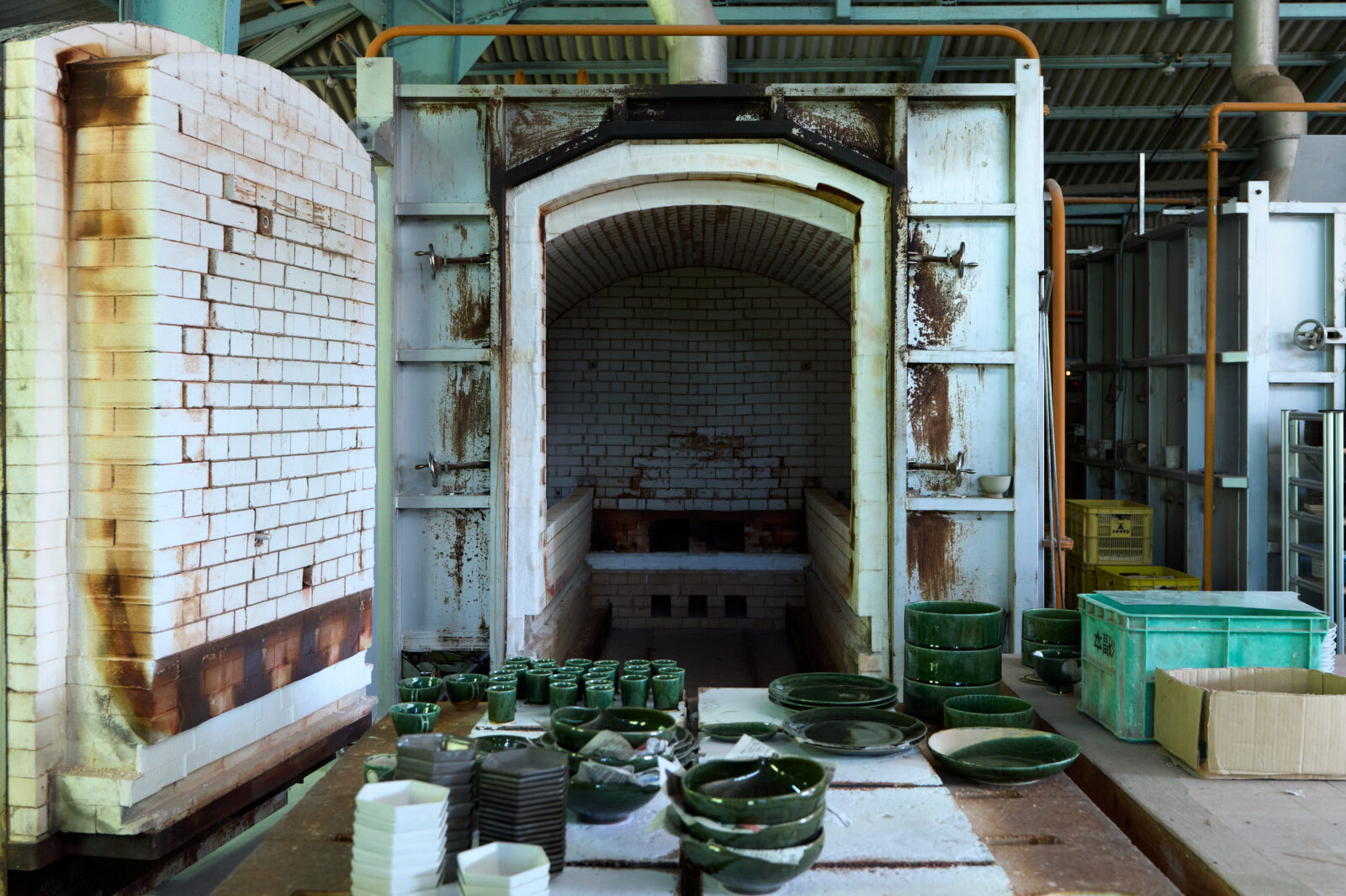
Wandering through the various sites and meeting different suppliers, I noticed that many of the machines, kilns, wheels, and clay extruders are decades old and still performing their duties. The workshops do not see a need to update or change them, as it would not make a meaningful difference to the craft. I found this quite poetic, and it is evident in the raw beauty of the pieces.
- Your work often balances precision with elegance. How did that play out when you started working with Fudogama’s ceramics?
With Mino Yaki objects, part of the beauty of the craft is that every piece becomes quite unique after firing. As a designer, there is not the same level of control over the final appearance of the objects that I have with other processes. We have had many discussions around shape, tolerance, and possibility, but there will always be unknowns and challenges.
My design for this project is about creating larger pieces through the assemblage of modular ceramic elements, so precision in the design of those components became essential. The balance sits between holding a clear view of the final object, while carefully resolving the individual parts accurately so they become uniform when combined.
I find elegance in the uniqueness of each application of glaze, both in observing individual results and in the effect they create as a whole. From a technical perspective, this very visible element sits in the hands of the craftsman. I can really only talk with Ito san about colour or movement, but his skill, combined with the heat and the glaze, ultimately defines the final feeling. Letting go of that control, and being open to the unknown, is an essential part of this piece.

- Was there a moment in the process when the material or technique surprised you and pushed the project somewhere unexpected?
As we learnt more about how the clay moves and shrinks, we had to adapt the profiles and consider additional supporting elements. The final design has changed quite a lot as I have become more familiar with the process and its intricacies. Initially, we were pushing the workshop toward a shape that was too much of a compromise to their best way of working, and this forced me to step back and reconsider what was truly important for the project.
It became less about compromise and more about adapting a traditional craft into a new idea, which is really the whole point of Craft x Tech. In the past, and with less experience, I have pushed fabricators to work in a certain way to achieve a specific result. In this case, it felt more important to arrive at a resolved outcome that celebrates both Mino Yaki and my ideas about the object. I appreciate working directly with the craftsman and being able to understand immediately what changes need to be made.

- Mino Yaki embraces diversity and experimentation. How did you find your own voice within such a rich tradition?
It was important for me to focus on a design language that is representative of my work. I wanted to create objects that are not typically associated with Mino Yaki and to challenge the usual scale and outcomes of the craft. For me, Craft x Tech is really about looking for new ideas by balancing the approach of designers with the methods and inherent beauty of traditional crafts.
I wanted to create something technical and modern, while still celebrating the unexpected and sometimes random beauty of Mino Yaki. At the same time, I was interested in challenging scales. Mino Yaki objects are traditionally smaller, so I began exploring ideas around modularity and assemblage as a way to create larger pieces. The final design came from a willingness to understand the Mino Yaki process and to work within it, allowing the beauty of the craft to remain central while introducing elements that counterbalance it and enable the creation of bigger, more technical objects.
- Has working so closely with this craft shifted how you think about ceramics or the role of handmade objects in design?
I have worked with ceramics before, but usually at a more industrial scale. This project is not yet complete for me, and I expect I will continue to learn more about working with the material as the objects are finished. That said, I do not think it will fundamentally change my view on the role of handmade objects in design. I already see this as an essential part of production that should be championed and preserved.
The best objects, whether furniture, clothing, products, or accessories, are often partially or wholly handmade. When that work is carried out by talented craftspeople, like those we are collaborating with, it brings not only beauty and refinement, but also experience, taste, and excellence to a product. There is also an increasing sense of rarity and prestige as automation continues to expand within the world of manufacturing.
David Caon (@caondesignoffice.com)
[Questions by Maria Cristina Didero]